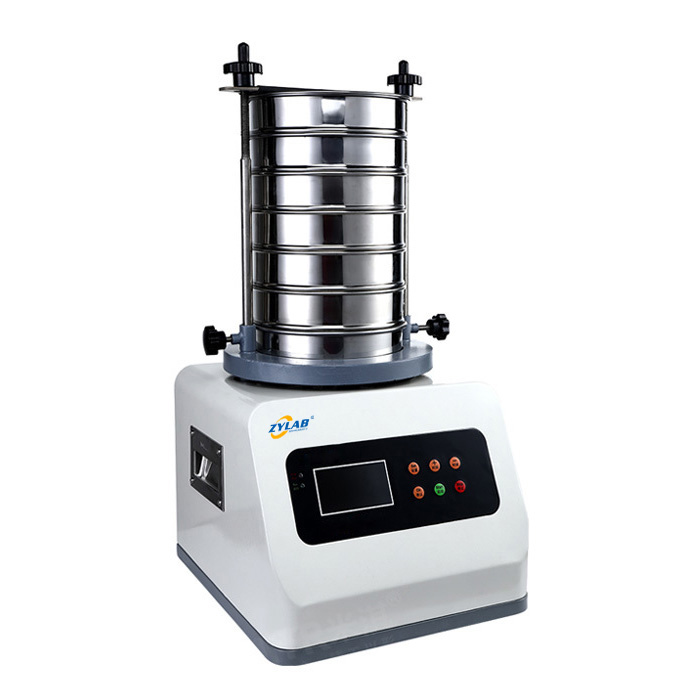
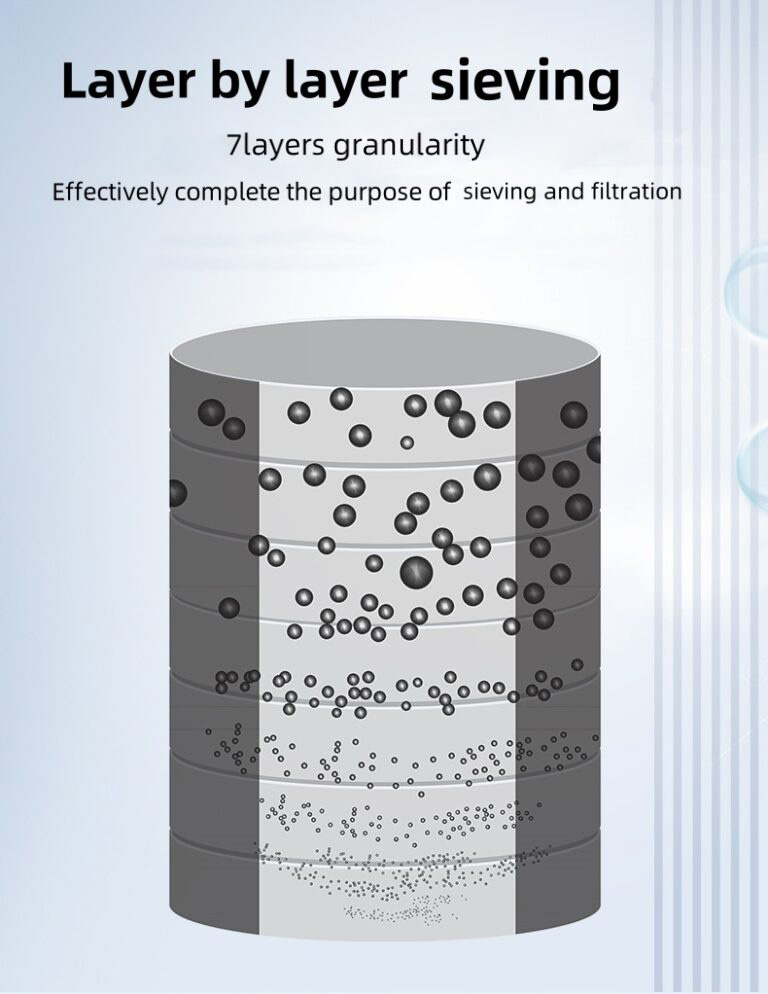
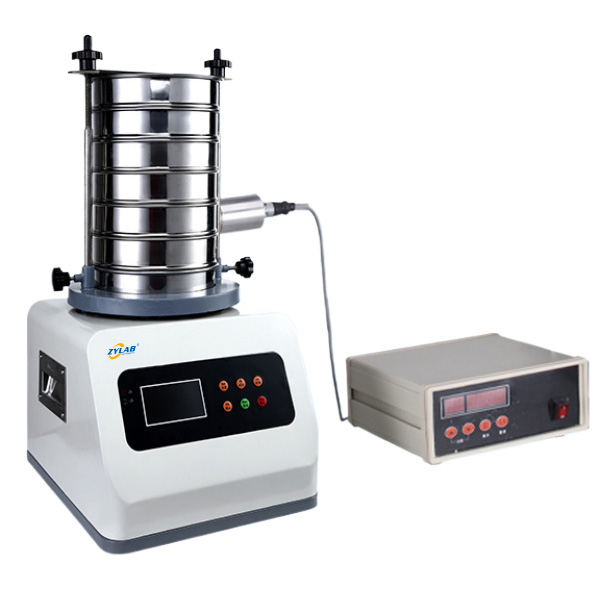
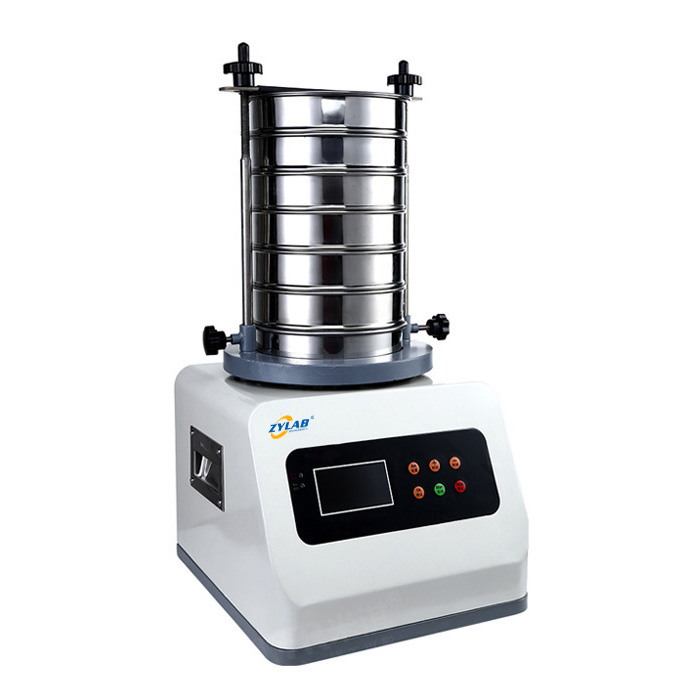
Multi-deck Laboratory Vibratory Sieve Shaker Introduction: The Vibratory Sieve Shaker uses a vibrating motor as the vibration source. The vibration of the motor drives the base of the sieve machine to vibrate, which then transmits the vibration to the standard test sieves placed on the base. This causes the material particles smaller than the mesh openings of the test sieve to be sieved into the lower layer of the test sieve. This process continues layer by layer, so that only material of the same particle size remains in each layer of the test sieve.This achieves the separation of different particle sizes and determines the particle size distribution of the material, effectively sieving, grading, and filtering the material in the test sieves. Features and Benefits of Vibratory Sieve Shaker: High efficiency, sophisticated and durable design, suitable for sieving any powder or liquid. Compact size, space-saving, and easy to move. The sieve machine can accommodate up to eight test sieves (including the bottom sieve), allowing precise separation of a granular material into 2 to 7 particle segments at the same time. Automatic shut-off timer. Ensures experiment repeatability. Fully functional and easy to operate. Low noise and lightweight. Platform operation, no need for fixation. Optional ultrasonic feature, suitable for ultrafine powder solutions. Sieve mesh material options include stainless steel and nylon. Technical Parameters of Vibratory Sieve Shaker: Model S-200 Sieve diameter 200mm Measuring range 0.025~3mm Motor power 0.125kw Sound Less than50 dB Amplitude 0~3mm Speed 1420rpm Overall dimension 400*300*300mm Net Weight 30Kg Power suppy 220V 50HZ Other Optional Models: Model S-200 S-300 S-400 S-600 Sieve Diameter 200mm 300mm 400mm 600mm Number of Sieve Layers 7 Layers 3 Layers Sieve Material Nylon/Metal Metal Sieve Selection Range 5-1000mesh Power 0.125kw 0.125kw 0.25kw 0.37kw Power Supply 220V 50HZ 380V 50HZ Applications: Vibratory Sieve Shakers are versatile laboratory tools used across various industries for particle size analysis, grading, and separation. Here are some common applications: Pharmaceutical Industry: Powder Screening: To ensure consistent particle size distribution in drug formulations, which affects drug release and absorption. Quality Control: Checking the granularity of excipients and active pharmaceutical ingredients (APIs). Chemical Industry: Powder and Granule Grading: Used to grade chemicals into different particle sizes for specific applications, ensuring uniformity in product batches. Catalyst Screening: To ensure catalysts have the correct particle size for optimal reaction rates. Food Industry: Flour and Powder Screening: To ensure uniform particle size in products like flour, spices, and baking powders. Quality Assurance: Ensuring consistency in products like sugar, salt, and other granulated food products. Construction Industry: Aggregate Testing: Grading sand, gravel, and crushed stone for concrete and asphalt production. Cement and Lime: To ensure proper particle size distribution for better mixing and bonding. Mining and Metallurgy: Ore and Mineral Screening: Used to classify ores, minerals, and coal according to particle size. Quality Control: Ensuring the consistency of raw materials for processing. Environmental Science: Soil Analysis: Determining soil particle size distribution for agricultural and environmental studies. Waste Management: Grading waste materials for recycling and processing. Cosmetics Industry: Powder Grading: To achieve consistent particle size in products like makeup powders and creams. Quality Control: Ensuring uniformity in raw materials and final products. Ceramics and Glass: Material Sizing: For precise sizing of raw materials used in ceramics and glass production. Consistency Testing: Ensuring the homogeneity of particle sizes for better product quality. Nanotechnology: Particle Size Analysis: For research and development of nanoparticles, ensuring precise size distribution in innovative materials. Academic and Research Laboratories: Research and Development: Used in various experiments to analyze particle sizes and distributions in different materials. Teaching Tool: Helps students understand the principles of particle size analysis and material separation. These applications highlight the importance of sieve shakers in ensuring product quality, consistency, and compliance with industry standards. For More Information on Vibratory Sieve Shaker Please read our article [Sieve Shaker] Get In TouchFill out the form below — free quote and professional suggestion will be sent for reference very soon! Name Email* Message Send